No Software Is Proprietary Anymore: ArtCraft and the AI-Built Adobe Alternatives
One developer used AI agents to rebuild 7 Adobe apps as open-source Rust software. What ArtCraft is, how it was built, and why software moats are shrinking.
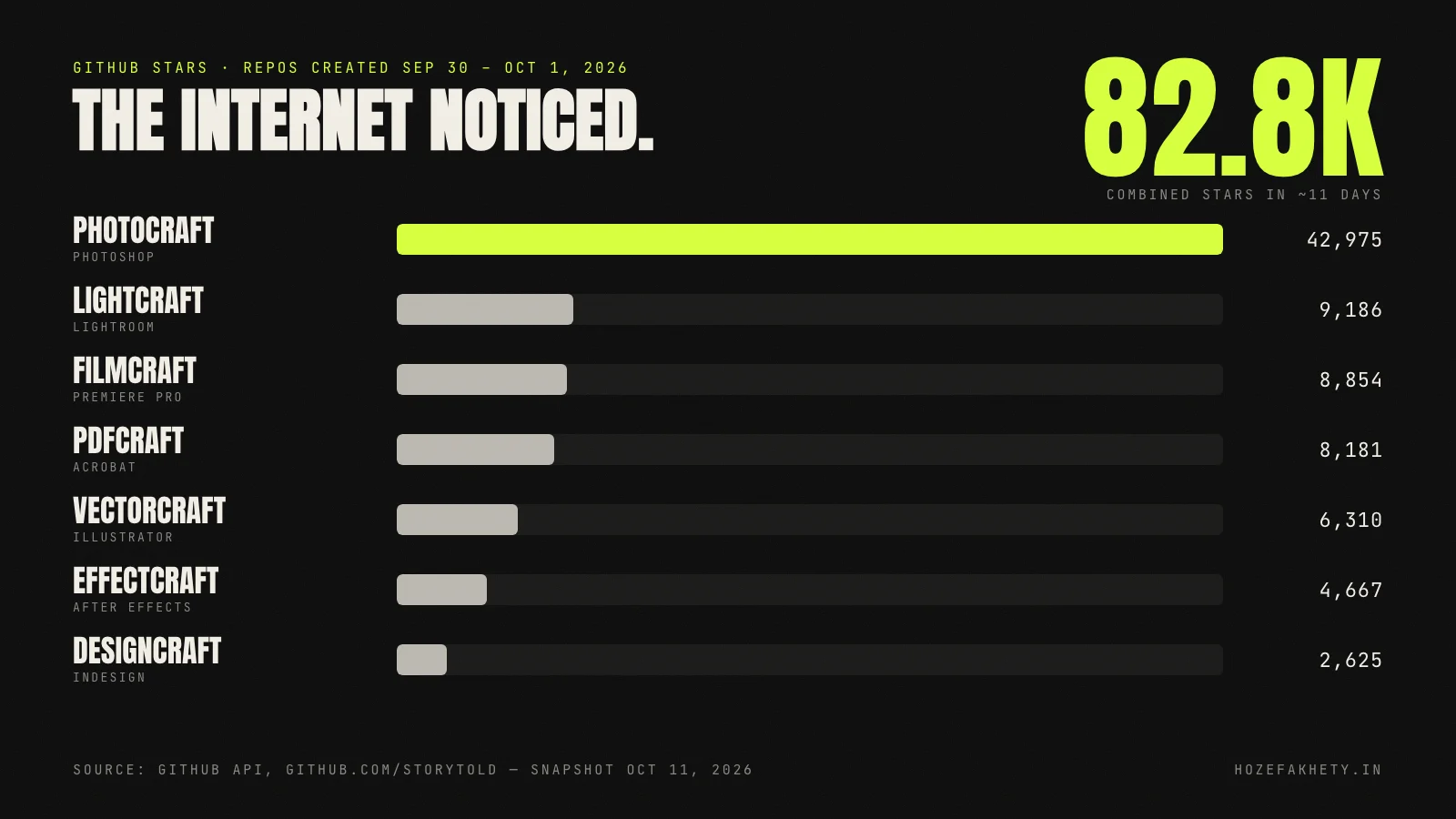
One developer just used AI to build open-source alternatives to seven Adobe apps: Photoshop, Illustrator, Premiere Pro, After Effects, Lightroom, InDesign and Acrobat. The project is called ArtCraft, and within about eleven days of the code going public, the repositories had collected more than 80,000 GitHub stars between them.
It's tempting to read that as "someone asked Claude to build Photoshop, but free." It isn't that simple, and that's not the interesting part anyway. The interesting part is that a project like this is even feasible for a tiny team to attempt. That says something important about where software is heading, and about what actually protects a software business from here on.
What is ArtCraft?
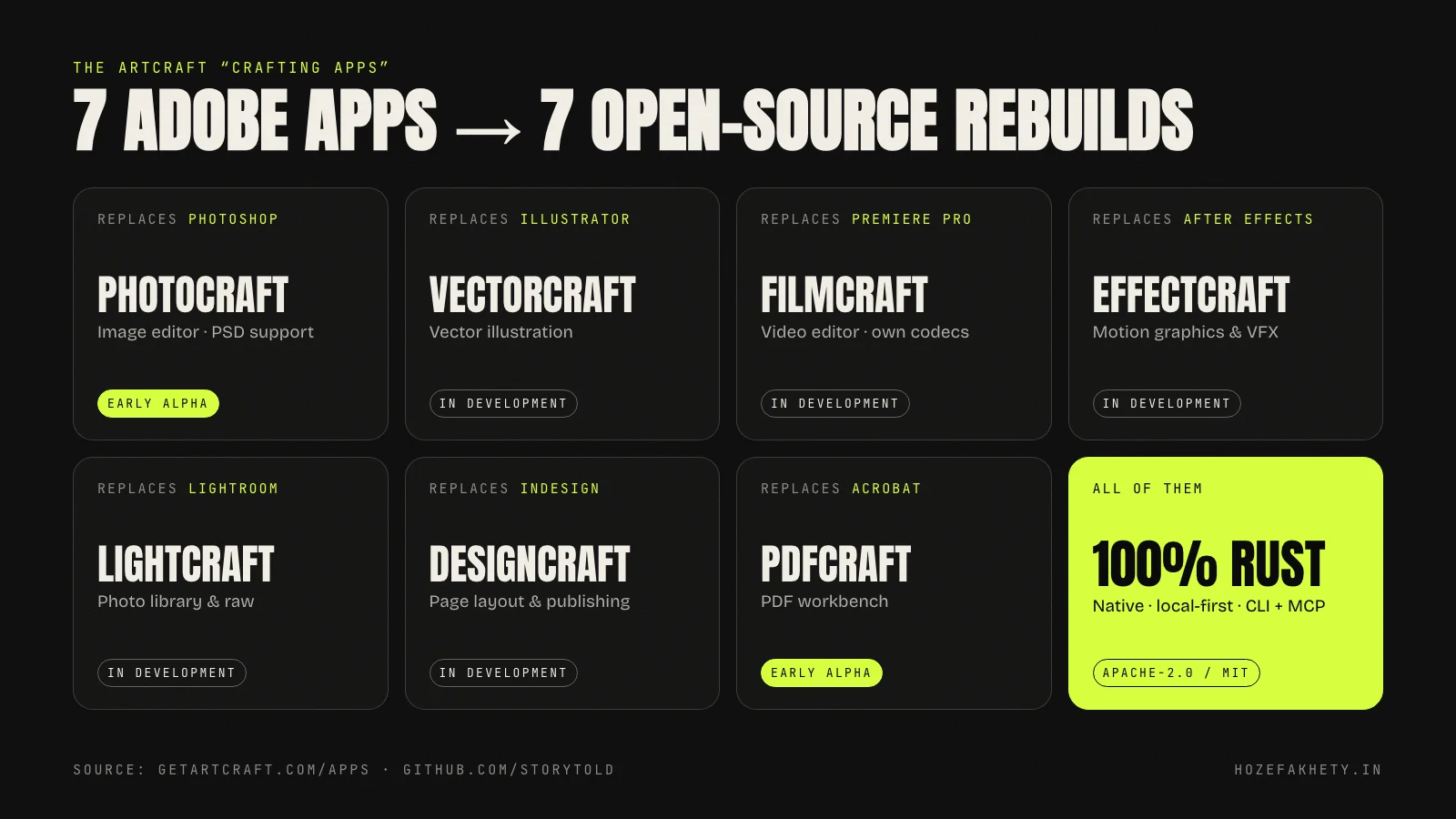
ArtCraft is a studio that makes open-source creative software. Its new suite, the "Crafting Apps", is seven native desktop applications written entirely in Rust. Each one is described in its repository as a clean-room reimplementation of an Adobe product: built from public specifications and observed behaviour, not from Adobe's code. They run on macOS, Windows and Linux, six of the seven also compile to WebAssembly so they run in the browser, and they work locally on your own files without an account.
| Adobe app | ArtCraft alternative | What it does | Status |
|---|---|---|---|
| Photoshop | PhotoCraft | Raster image editing with layers, masks and PSD support | Early alpha |
| Illustrator | VectorCraft | Vector illustration | In development |
| Premiere Pro | FilmCraft | Video editing (desktop only) | In development |
| After Effects | EffectCraft | Motion graphics and VFX | In development |
| Lightroom | LightCraft | Photo library and raw development | In development |
| InDesign | DesignCraft | Page layout and publishing | In development |
| Acrobat | PdfCraft | Read, combine, split and secure PDFs | Early alpha |
A few design choices stand out. The apps deliberately copy the menus, panels and keyboard shortcuts professionals already know. PhotoCraft's README puts it bluntly: "If you know Photoshop, you already know PhotoCraft." They're native rather than Electron wrappers, with PhotoCraft compositing on the GPU through wgpu. And every action is exposed through a CLI, a JSON control channel and an MCP server, so an AI agent can drive the apps as easily as a person can.
How one developer rebuilt Adobe with AI coding agents
The project is led by Brandon Thomas, who has reportedly spent around a decade on large Rust codebases. According to coverage of the launch, the code was written with Claude Opus 5.5, with several Claude agents working in parallel and each repository carrying the CLAUDE.md files that Claude Code reads for project rules. Thomas has said the trigger was personal: he'd been hit with an Adobe cancellation fee one too many times.
The workflow matters more than the model. This wasn't one giant prompt. It was an experienced engineer setting up architecture, conventions and test suites, then letting a fleet of agents grind through hundreds of features in parallel while checking their own work against those tests. PhotoCraft alone ships with a large test suite and a public corpus of PSD files it's measured against. That's the part people miss when they say "AI built it." Here, the AI did the typing; the engineering judgement still had to come from somewhere.
And it isn't stopping at Adobe. The same GitHub organisation already has early repositories for Word, Excel and PowerPoint equivalents (WordCraft, GridCraft, DeckCraft), an AutoCAD-style CAD app and a Pro Tools-style audio app. Whatever you think of the approach, the ambition is clearly "all of it."
Why "build me Photoshop, but free" isn't one prompt
Recreating mature software is incredibly nuanced. Photoshop has had more than three decades to accumulate edge cases, workflows, performance optimisations and features that people's livelihoods now depend on. None of that disappears just because an AI can write code.
- File formats are the real boss fight. PSD is a sprawling, partly undocumented format. PhotoCraft reports keeping the render of 307 of 309 files in the psd-tools test set when re-saving, which is impressive, but working designers will open files nobody has tested.
- Parity is a long tail. ArtCraft's own roadmap has reportedly said true parity with Photoshop is "still well below 50%". The first 50% of features is the easy half.
- Performance under pressure. A 4K timeline with effects, or a 2GB layered document, exposes problems no demo will.
- Reliability is a feature. A creative tool that crashes once on deadline day loses that user for good.
So ArtCraft still has a lot to prove. PhotoCraft and PdfCraft are labelled early alpha; the rest are in development. I wouldn't tell an agency to cancel Creative Cloud tomorrow. But judging the project only by whether it beats Photoshop today misses the point.
Piracy dressed up as open source, or progress?
Some people will call this software piracy dressed up as open source. Others will call it the natural evolution of software development, where AI makes powerful tools accessible without expensive subscriptions.
Legally, clean-room reimplementation has a long history. It's how the IBM PC BIOS was cloned in the 1980s, and it's broadly the same idea that lets LibreOffice open Word documents. Copying behaviour, interfaces and file formats is very different from copying source code. Whether Adobe sees it that way is a separate question, and copying an interface this closely, with AI in the loop, is new enough territory that I'd expect it to be tested.
The bigger shift isn't legal or ethical. It's economic: the cost of recreating software is collapsing.
The real story: the cost of recreating software is collapsing
For decades, proprietary software had a moat built on the sheer time, money and engineering talent needed to build a credible alternative. If you wanted to compete with Photoshop, you needed years, a large team and serious funding just to reach the starting line. Most challengers never got there.
AI is starting to chip away at that moat. When a single experienced engineer can direct a fleet of coding agents to produce a working, if rough, version of seven professional applications in weeks, "it would take too long to copy us" stops being a strategy.
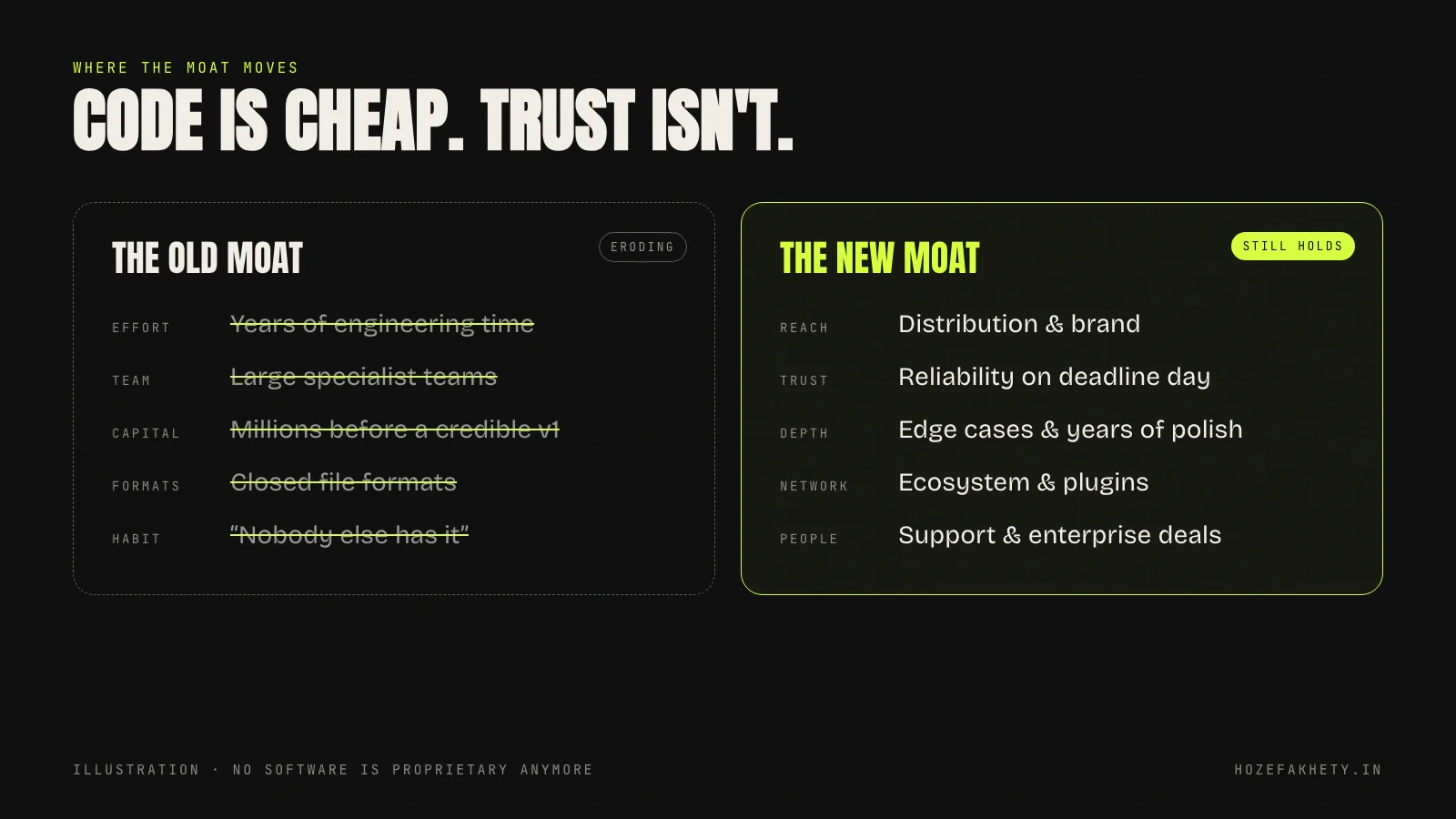
That doesn't mean every paid product is suddenly replaceable, or that open source automatically wins. Distribution, reliability, support, trust and years of refinement still matter, and arguably they matter more now, because they're the parts AI can't generate overnight. The balance of power between the people who build software and the people who use it is shifting all the same.
What this means if you're building a product
I build mobile and web apps for founders, and this is the conversation I keep having. If code is no longer the moat, the question becomes: what is?
- Own the workflow, not just the features. A feature list can be cloned in weeks. A product woven into how a team works every day is much harder to rip out.
- Invest in data and integrations. Proprietary data, network effects and deep integrations are things an AI agent can't reimplement from public specs.
- Make reliability visible. Uptime, support response times and stability are selling points again.
- Use the same leverage. The tools that let ArtCraft rebuild Adobe let you ship an MVP faster and cheaper than ever. If you're budgeting a build, my breakdown of what an app MVP costs in 2026 is a good starting point.
- Build AI-native from day one. ArtCraft exposes every action through MCP so agents can use the apps. Products that plug cleanly into AI workflows, often through approaches like RAG, will have an edge.
Key takeaways
- ArtCraft has released seven free, open-source, Rust-based alternatives to Adobe's flagship apps, built largely with Claude coding agents.
- They're early: PhotoCraft and PdfCraft are in early alpha and full feature parity is a long way off.
- Clean-room reimplementation is a legitimate technique, but AI-assisted cloning at this scale is new legal ground.
- The bigger signal is economic. Rebuilding software is getting dramatically cheaper, so being proprietary is no longer enough to protect you.
Frequently asked questions
Is ArtCraft really free?
Yes. The Crafting Apps are free to download and use, and the source code is on GitHub under permissive licences (GitHub lists Apache-2.0, and the READMEs offer MIT or Apache-2.0). The editing apps don't require an account. ArtCraft's broader business is an AI image and video studio.
Can PhotoCraft replace Photoshop today?
Not for most professionals yet. PhotoCraft is an early alpha. It already handles layers, masks, adjustment layers, layer styles, type and real PSD files, but by ArtCraft's own reported estimate, full parity with Photoshop is still well under half-way.
Is it legal to clone Adobe software with AI?
Clean-room reimplementation, rebuilding software from public specifications and observed behaviour without copying source code, has a long legal history. ArtCraft says its apps are built this way. How courts treat close interface copying done with AI hasn't really been tested yet, so treat it as an open question rather than settled law.
Which AI was used to build ArtCraft?
According to launch coverage, the code was written with Claude Opus 5.5 running as multiple parallel coding agents, directed by an experienced Rust developer. The repositories include CLAUDE.md files, which Claude Code uses for project instructions.
Where can I download the ArtCraft apps?
From getartcraft.com/apps. The ArtCraft Launcher installs and updates all of them, and each app's GitHub repository under github.com/storytold also has its own installers.
Maybe the future isn't that proprietary software disappears overnight. Maybe it's that being proprietary is no longer enough to protect you. Whether you see that as piracy, progress or a bit of both, one thing seems pretty clear: software development will never be the same again.
I first shared a shorter version of this on LinkedIn. If you're figuring out how AI changes what you should build, or how fast you can build it, I'm happy to talk it through.
Have a project in mind?
I build mobile and web apps for founders and teams — and the first consultation is free.
Get in touch ↗